
For years, my attempts at getting healthier lasted 4 to 6 weeks before something knocked them over. Work got busy, a week went wrong, and I was back to waiting for the next Monday.
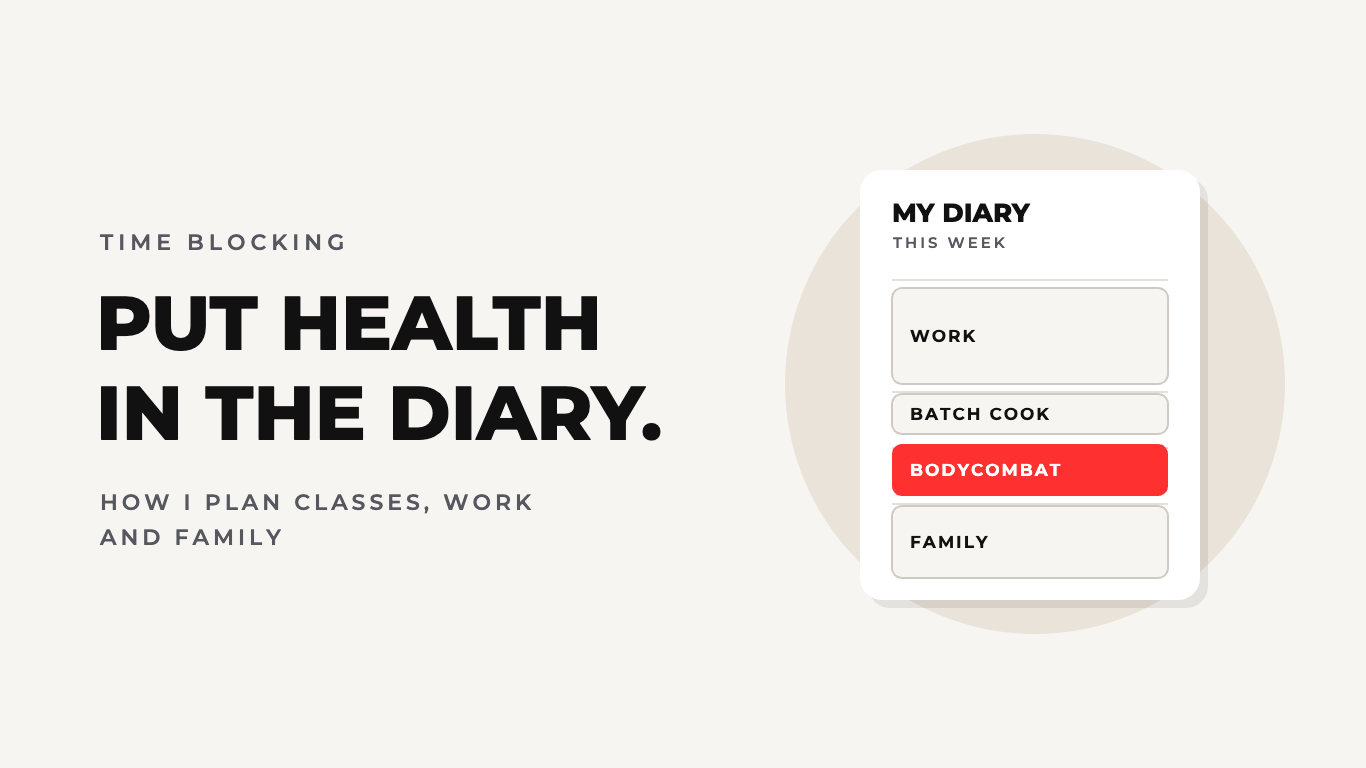
These days my week is still full. I teach 4 to 5 BODYCOMBAT classes a week, alongside my consulting work and time with my kids. What has changed is how I plan it. I treat my health like any other appointment and put it in the diary, because if it isn’t in the diary, it tends not to happen.
What time blocking actually means
Time blocking just means giving something its own slot before the week fills up. Instead of hoping you’ll find time for a workout, you decide on the day and the time in advance, the same way you would for a meeting.
There is good reason it works. Psychologists call this forming an implementation intention, and studies have found that deciding in advance when and where you’ll do something makes you more likely to follow through than simply meaning to.
It starts with my Sunday review
Every Sunday I sit down and look at what’s coming: work, the classes I’m teaching and family plans. Then I put my workouts in where they’ll actually fit. It only takes a few minutes, and it is also when I look back at the week just gone: what worked, what didn’t, what next.
Sunday is also when I batch cook. The slow cooker goes on and my lunches for the week get sorted in one go, so food is already planned before Monday arrives.
What a typical week looks like for me
No exact times, because they move around, but this is the shape of my week. The BODYCOMBAT classes I teach on Wednesday, Friday and Sunday are the fixed points. They go in first, and everything else fits around them.
- Monday: rest
- Tuesday: strength
- Wednesday: teaching BODYCOMBAT
- Thursday: rest
- Friday: teaching BODYCOMBAT
- Saturday: rest
- Sunday: teaching BODYCOMBAT, plus my weekly review and batch cook
It isn’t a perfect timetable. The point is that each part of looking after myself has a home in the week before work and everything else claims the space.
How I block out each part
- Training. Workouts go in the diary like a meeting. I used to go to BODYPUMP 3 to 4 times a week; now it’s more like 1 or 2 classes a month, and I practise at home with my own BODYPUMP kit. That means I can get a session in without needing to be at the club at a set time, which makes it far easier to fit around everything else.
- Rest. My key rest days are usually Monday, Thursday and Saturday, and I plan them just as deliberately as the busy days. A planned rest day doesn’t feel like failing. I wrote more about why in Rest is part of the plan.
- Food. The Sunday batch cook is the block that saves me most. When lunch is already in the fridge, I don’t have to think about food midweek, and I’m not relying on whatever is quickest.
- Energy and sleep. A teaching day and a rest day are not the same day, so I plan food and recovery around the difference. My caffeine cut off is 1pm, and I track the quality of my sleep on my Apple Watch rather than chasing a neat 8 hours. There is more in Energy management.
- Time in the studio. A class is a workout, but it is also time where I’m not thinking about work or anything else. That is worth protecting too.
When the week doesn’t go to plan
Plenty of weeks don’t. Schedules change, there’s a meal out, a social plan appears. The old me would have written the week off and started again on Monday.
Now, if something clashes, I move the slot rather than delete it. I get a workout in where I can and go back to the basics I know work for me, starting with the batch cook. A missed slot is a blip, not a restart. I go into this more in Had a bad week? What I do instead of starting again.
How to block out time for your own health
Your week will look nothing like mine, and that is fine. You don’t need an app or a complicated system. A calendar on your phone or a notebook is enough.
- Pick 1 time a week to plan. Sunday works for me. 5 minutes is plenty to start.
- Put the fixed things in first. Work, family and anything you can’t move. Then you can see where the gaps really are.
- Book 2 or 3 health slots. A walk, a class, a short session at home or 30 minutes to make lunches all count. Give each one a day, a time and a length.
- Plan food for your busiest days first. Those are the days you’re most likely to grab whatever is quickest.
- Book your rest. Rest days belong in the diary too.
- Move it, don’t delete it. When something clashes, find another slot that week rather than writing it off.
I’m a Les Mills BODYCOMBAT instructor and I’ve enrolled on a nutrition course with MNU, but I’m not a personal trainer or a qualified nutritionist. This is how I plan my own weeks, not a plan for anyone else. If you have a health condition or take regular medication, speak to your GP or a registered professional before changing your routine.
If you’d like somewhere to start, my free Kickstart Your Fitness checklist has 10 small first steps, and you only need to pick 1. Book it into your week and give it 2 weeks.
This is my journey. Yours will be unique.