
For a long time I treated rest as the thing that happened when I couldn’t train. A quiet week felt like I’d let something slip. Teaching BODYCOMBAT made that feeling stronger, because classes run on a timetable whether you feel fresh or not, and people are relying on you to turn up.
What changed my thinking was my shoulder.
The injury I kept working around
In 2025 I was fitting in 10 to 12 classes a week, a mix of the BODYCOMBAT classes I teach and other classes I attend. I also had a partial tear in my rotator cuff. For a while I did what a lot of us do: I adapted what I was doing, worked around it and kept going.
In the end it needed surgery. In October and November 2025 I stepped back from teaching completely, and around 18 of my classes were handed over to other instructors or cancelled. For someone whose week is built around the studio, that was a big gap.
I came back, and in January 2026 I was teaching the BODYCOMBAT 105 launch. But the time away changed how I think about the days when I’m not training.
These days I teach 4 to 5 BODYCOMBAT classes a week, and the rest of my training looks different. I used to go to BODYPUMP 3 to 4 times a week. Now it’s more like 1 or 2 classes a month, mostly because of my schedule. Instead, I practise at home. I bought the BODYPUMP equipment for home and it’s been a great investment, because I can still get a session in without needing to be at the club at a set time.
Why rest is part of training
Training puts your body under stress. The getting fitter and stronger part happens afterwards, while you recover. Skip the recovery and you don’t get more of the benefit, you just pile up more of the stress. That’s the simple version, and it was the bit I understood in theory long before I actually lived it.
Rest also doesn’t have to mean doing nothing. During an earlier break from teaching I spent more time in BODYBALANCE and BODYPUMP. BODYBALANCE in particular gave me something I hadn’t expected: a slower, more mindful session that left me feeling better rather than more tired. Walking counts too. It was my first real step into fitness, and it’s still one of the easiest ways I know to move without adding to the load.
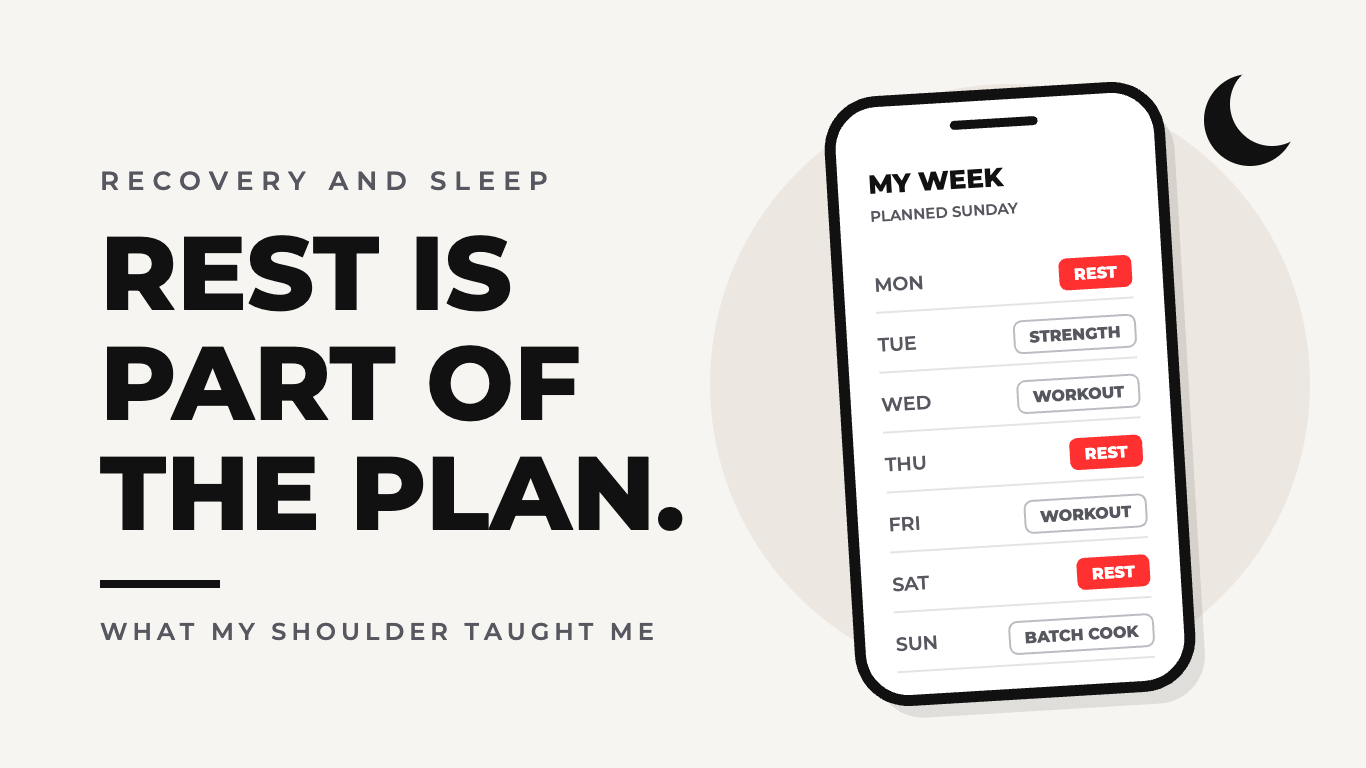
My key rest days are usually Monday, Thursday and Saturday. Beyond that I rest when I can, and balancing it properly is something I know I still need to work on. What has changed is how I think about it. With my classes it’s always quality over quantity, and I try to apply the same idea to recovery.
Where sleep fits in
Sleep is where a lot of that recovery happens, and it’s usually the first thing to go when life gets busy. The NHS suggests most adults need somewhere between 7 and 9 hours a night. I’ll be honest: I don’t get a neat 8 hours. Between work, my kids and evening classes, that isn’t how my weeks run.
So I focus on the quality of my sleep instead. My Apple Watch tracks it, and I pay attention to how much REM and deeper sleep I’m actually getting rather than just counting the hours. Having that in front of me helps a lot.
The basics are not exciting, but they’re the ones that tend to help: a fairly regular bedtime and wake time, a caffeine cut off earlier in the day, and some time away from screens before bed. None of it needs to be perfect. A bit more consistency is enough to notice a difference.
If you’re restarting, plan your rest like your workouts
Every Sunday I look at the week ahead and put my workouts in the diary, with Monday, Thursday and Saturday as my main rest days. Rest is still the part I’m getting better at, but it now has its own space in the week. It’s part of the plan, not a sign the plan has gone wrong.
- Put rest days in the diary. If a rest day is planned, taking it doesn’t feel like failing.
- Keep some days gentle. A walk or a slower, stretch based session still counts as looking after yourself.
- Treat a missed session as a blip, not a restart. One day off doesn’t undo anything. Writing off the whole week does.
- Get pain checked. Working around an injury for too long is the lesson I’d most like you to skip. If something isn’t settling, speak to your GP or a physio.
I’m a BODYCOMBAT instructor and I’m studying nutrition, but I’m not a physio or a doctor. This is what I’ve learned from my own shoulder and my own weeks, not medical advice.
If you’d like a simple way to plan your weeks, including the rest days, my My Journey Starter Workbook walks you through it one week at a time.
This is my journey. Yours will be unique.