December is the month when most routines quietly fall apart. The diary fills up, the evenings get dark early, and there is food everywhere you look. For a long time my answer was to give up on December completely and promise myself a fresh start in January.
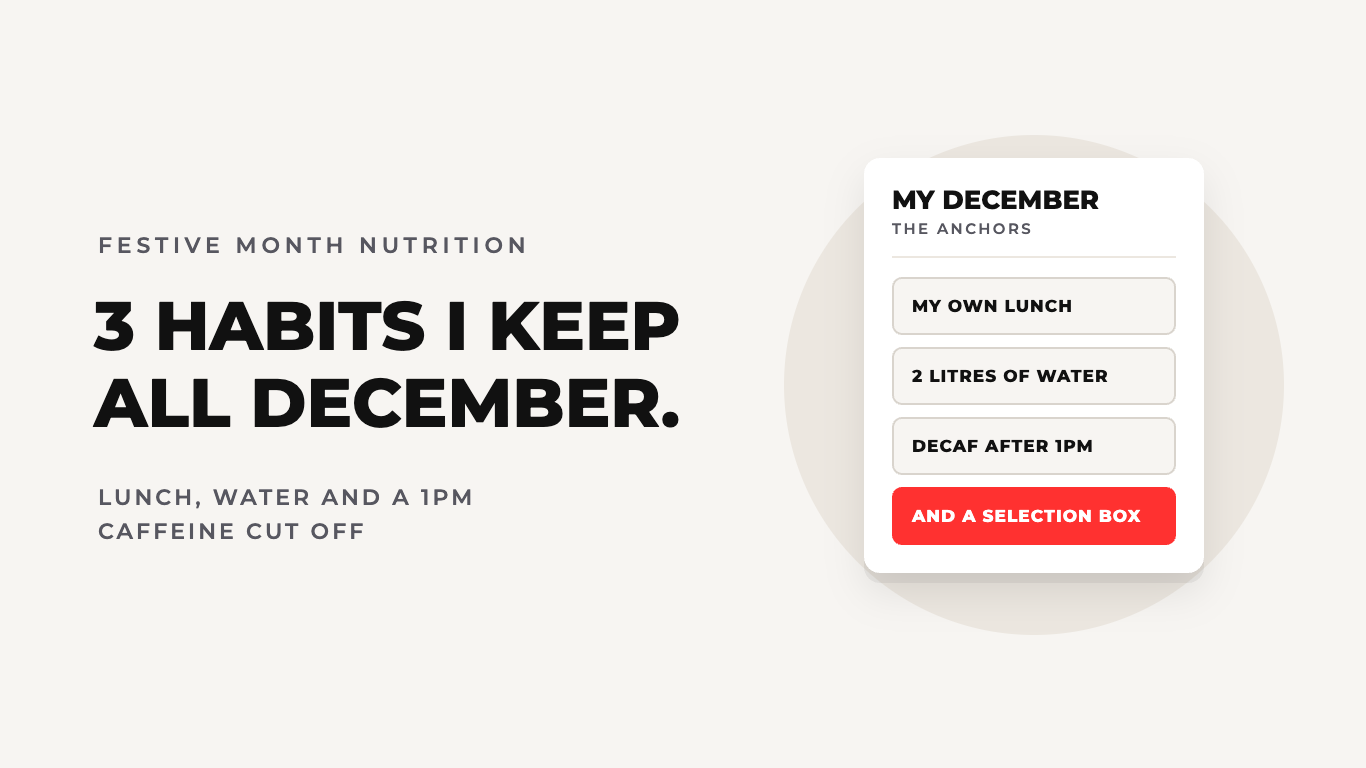
That fresh start never felt fresh. It felt like starting again from nothing. So these days I do December differently. I don’t follow a festive diet and I don’t try to be perfect. I keep 3 everyday food habits going all month, and I enjoy the rest.
Why anchors rather than rules
A rule is something you can break, and once it’s broken it is easy to decide the whole month is a write off. An anchor is different. It is a small, ordinary habit that stays in place while everything around it moves. If Tuesday is chaotic, the anchor still happens. If Friday involves more chocolate than planned, the anchor is still there on Saturday.
My 3 anchors aren’t new. They are the same habits I keep the rest of the year. That is exactly why they work in December: they don’t need any extra willpower.
1. I make my own lunch on normal days
Looking back, the biggest early change I made with food was making my own lunch instead of grabbing whatever was quickest. It is still one of the simplest habits I keep.
On a normal working day in December, lunch looks the same as it does in October. I batch cook on a Sunday, so it is already sorted before the week starts. The word that matters is normal. If there’s a lunch out or a festive meal, I enjoy it. The other days stay the same, and that’s what stops a few special meals turning into a month of grabbing whatever is nearest.
2. I drink 2 litres of water a day
I aim for 2 litres a day and track everything I drink in the My Water app on my iPhone, tea and coffee included. Once I’ve reached 2 litres I stop counting and go by the colour of my urine instead. The NHS suggests pale yellow is a good sign; clear isn’t the goal.
Water is easy to forget in winter because you don’t feel thirsty in the same way you do in summer. Tracking it takes a few seconds, and it is one habit I can keep on the busiest day of the month.
3. Caffeine stops at 1pm
My caffeine cut off is 1pm. If I want a coffee after that, it’s decaf. It sounds boring, and it made a real difference to how I sleep and how I feel the next morning.
It matters even more in December. Later nights are more likely, so I protect the sleep I can get. I care more about the quality of my sleep than about hitting a perfect number of hours, and a 1pm cut off is one of the easiest ways I know to look after it. I wrote more about that side of things in Energy management: matching training and food to your day.
What I don’t give up
Chocolate. A selection box is part of December for me and I’m not going to pretend otherwise. I enjoy it without feeling guilty, because it sits alongside my anchors rather than replacing them.
That is the whole point. The anchors aren’t there to stop you enjoying festive food. They are there so that enjoying it doesn’t cost you everything else.
Pick 1 anchor and keep it until New Year
You don’t need 3. If December already feels full, choose 1 small habit you know you can keep on your busiest day, and keep it until New Year. A few ideas to start from:
- A planned lunch on working days. Even a simple one you made yourself.
- A daily water target. Pick a number that suits you and track it for a few seconds a day.
- A caffeine cut off. Choose a time that protects your sleep.
- Something else that is already yours. The best anchor is a habit you already do most days, not a new one.
If you find it hard to fit habits around everything else in December, putting them in the diary helps. I explain how I do that in Time blocking for health.
January as a continuation
When 1 January arrives, I don’t need a new plan. My lunches, my water and my caffeine cut off are already there, so January is simply the next month rather than a restart. That has made a bigger difference to me than any fresh start ever did.
I’m a Les Mills BODYCOMBAT instructor, not a personal trainer or a qualified nutritionist. This is what works for me, not a plan for anyone else. If you have a health condition or take regular medication, speak to your GP or a registered professional before changing how you eat or drink.
If you’d like a small place to start, my free Kickstart Your Fitness checklist has 10 small first steps, and you only need to pick 1.
This is my journey. Yours will be unique.