Most people I meet who want to get healthier have already started more than once. A new plan in January, a gym membership, a diet that lasted 3 weeks. Then work gets busy, a week goes wrong, and it all goes back on the shelf until the next Monday.
I know that cycle well. What finally changed things for me was not a bigger plan. It was a smaller one. My first real habit was walking 4.5 km to work, and everything else came later, 1 step at a time.
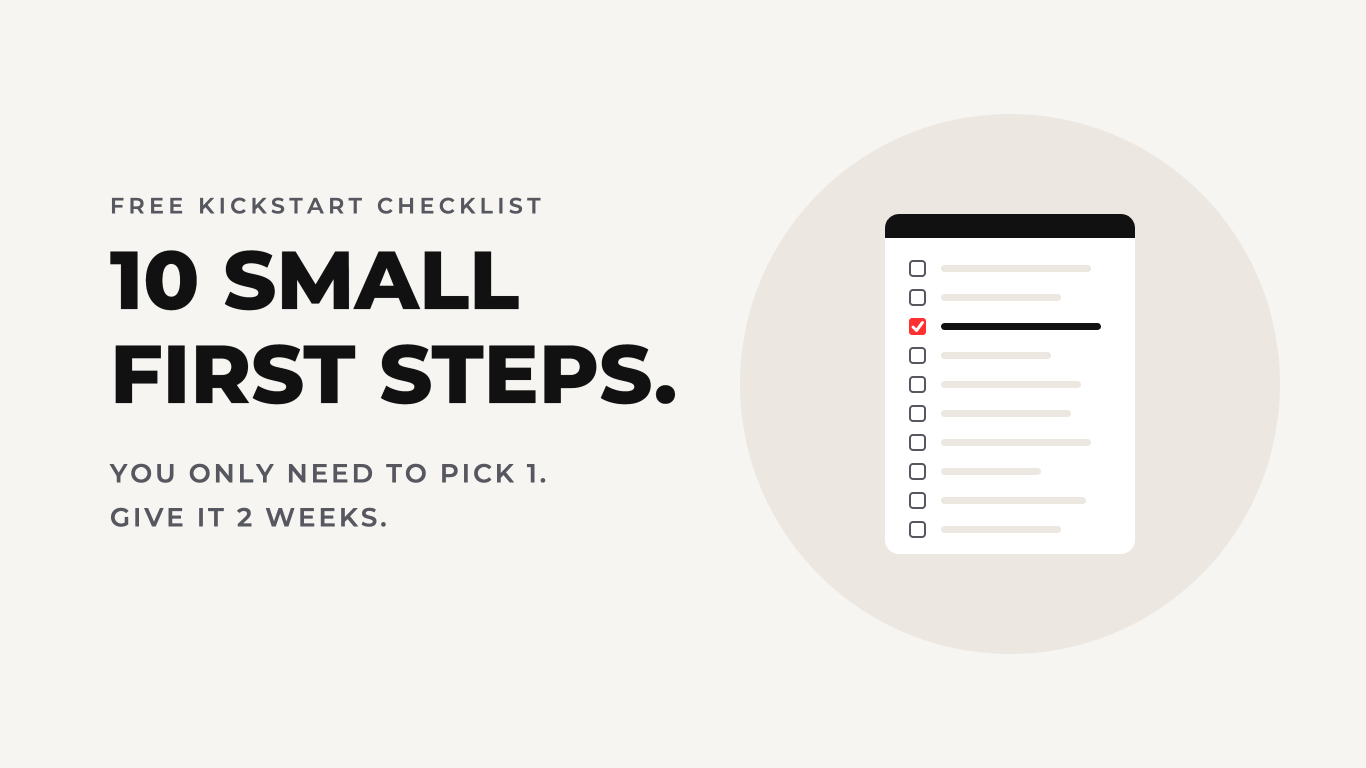
That is why I put together the free Kickstart Your Fitness checklist. It has 10 small first steps, and you only need to pick 1. This post walks through each of them, what it looked like for me, and how to choose where to start.
Why small steps work when big plans don’t
A big plan asks you to change everything on the same day: food, exercise, sleep, the lot. It feels motivating on day 1 and impossible by day 10. When one part slips, the whole plan feels broken, so it is easy to stop.
A small step works differently. It fits into the week you already have. It is easy to repeat on a bad day, and once it feels normal you have room to add the next one. Consistency over perfection is the idea behind everything on this site, and it starts here.
The 10 small first steps
1. Choose 1 walk you can repeat this week
Mine was 4.5 km to work. It did not need a gym, kit or anyone watching, and it fitted into a day I was already having. Pick a walk you can repeat, not the longest one you can manage once. I wrote more about it in why walking was the best first step I took.
2. Track your water for 7 days
Just notice, no targets yet. Drinking more water was one of the changes that made the biggest difference for me, but it started with simply paying attention to how much I was actually having.
3. Make your own lunch on 3 days
This was one of my first food changes and it is still one of the simplest I keep. When lunch is already made, you are not relying on whatever is quickest when you are short on time. 3 days is enough to see the difference without making it a chore.
4. Pick a caffeine cut off time
Mine is 1pm. After that it’s decaf if I’m craving one. It sounds boring, and it made a real difference to how I slept and how I felt the next day.
5. Plan and prep 2 meals ahead
Not a full meal plan, just enough to take the pressure off a busy day. These days I review the week every Sunday and batch cook, and the slow cooker is my go to when I’m stuck for ideas. You don’t need to start there. 2 meals is plenty.
6. Choose how you will track progress beyond the scales
The scales only tell you one thing, and they can move for all sorts of reasons. Decide on 1 other sign you will watch, such as how your clothes fit, how far you can walk, your energy in the afternoon or how well you sleep. It keeps you going on the weeks the number doesn’t move.
7. Try 1 strength session or class
Whatever feels least intimidating to you. Gym intimidation was one of the hardest parts for me, so I understand if this one feels big. I spent about 2 years attending BODYCOMBAT classes before I qualified to teach in August 2024, and I started at the back. If a class is your step, here is what to expect from your first one. A short session at home counts just as much.
8. Set a regular bedtime
Sleep affects your energy, your food choices and how much you feel like moving. I don’t get a neat 8 hours, so I pay attention to the quality of my sleep on my Apple Watch instead. A regular bedtime is the easiest place to begin. There is more on this in Rest is part of the plan.
9. Decide where you will get proper help
Your GP, a registered dietitian or nutritionist, or a trainer for a few sessions. Working with a nutritionist was one of the things that made the biggest difference for me. You don’t have to work it all out on your own, and some things shouldn’t be.
10. Do a 5 minute weekly check in
What worked, what didn’t, what next. Mine happens on a Sunday when I look at the week ahead. It is the step that holds the others together, because it is where you notice what is sticking and decide what to add.
How to choose your first step
Please don’t try all 10 at once. Read the list again and pick the one that feels almost too easy. That is usually the right one.
- Pick 1 step. Circle it on the checklist or write it somewhere you will see it.
- Give it 2 weeks. Long enough to see whether it fits your life, short enough to feel doable.
- Check in at the end of each week. If it feels normal, add the next step. If it doesn’t, make it smaller rather than dropping it.
- Expect a bad week. One will come. It is a blip, not a reason to start again from scratch.
Get the free checklist
The Kickstart Your Fitness checklist has all 10 steps on a single page, with what I did for each one and space for your own version. When you sign up you get the checklist straight away, followed by 3 short emails over 2 weeks: why I changed 1 thing at a time, the food changes that mattered, and what to do after a bad week.
If you’d like more structure once the first steps feel normal, My Journey Starter Workbook (£9) takes you through 6 weeks, 1 simple change at a time.
I’m a Les Mills BODYCOMBAT instructor and I’m studying nutrition with MNU, but I’m not a personal trainer or a qualified nutritionist. These steps are what helped me, not a plan for anyone else. If you have a health condition, take regular medication, or you are unsure whether a change is right for you, speak to your GP or a registered professional before you start.
This is my journey. Yours will be unique.