
Every January I used to sit down with a year of diary entries, bank statements and a carrier bag of receipts, trying to work out how far I had driven and what I had spent. It took a whole weekend, and I always had the feeling I had missed something.
If you teach at several gyms, you probably drive a lot more than you think. A few miles here and there between venues soon adds up to hundreds of miles a year.
This is how I keep it under control now.
1. Log each trip on the day
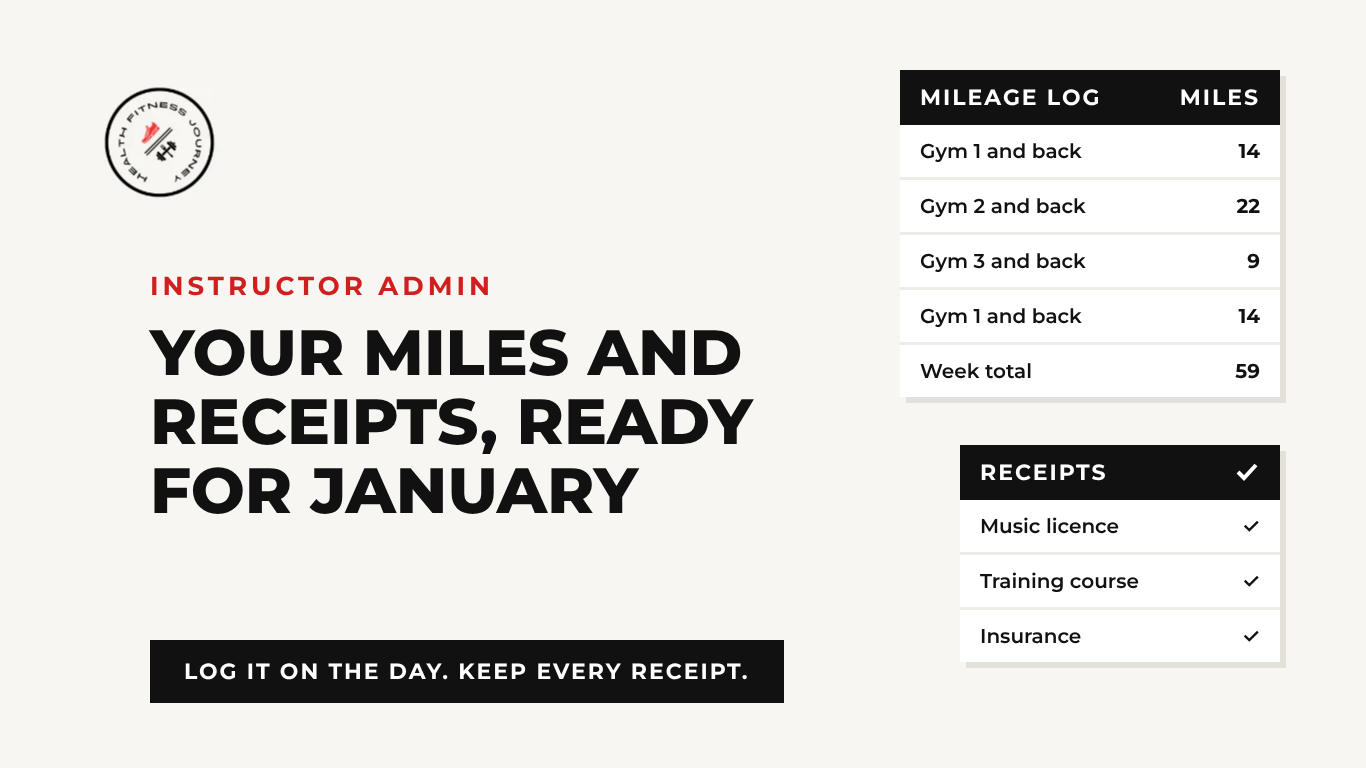
I note the date, where I drove from and to, why, and the miles. Most of my trips are the same few gyms, so I wrote down the round trip miles for each one once, and now I just pick the gym.
It takes seconds after each class. Trying to rebuild a year of trips from memory takes hours, and it is far less accurate.
2. Use the right rate for the right year
If you use simplified expenses, HMRC sets a flat rate per business mile for cars and vans. You claim that instead of working out fuel, insurance, servicing and so on.
The rate changed recently, so this one matters:
- 6 April 2025 to 5 April 2026: 45p a mile for the first 10,000 business miles, then 25p
- From 6 April 2026: 55p a mile for the first 10,000 business miles, then 25p
- From 6 April 2027: the rate after 10,000 miles goes up to 35p
The return due on 31 January 2027 covers 6 April 2025 to 5 April 2026, so those journeys are at 45p. Your 2026 to 2027 trips, which you will report a year later, are at 55p.
Once you choose simplified expenses for a vehicle, you have to keep using that method for as long as you use that vehicle for your business. The GOV.UK page on simplified expenses for vehicles explains it.
3. Know which journeys count
Which trips count as business travel depends on how you work, for example whether you have a regular base. HMRC has guidance on this, and if you are not sure, an accountant can check your situation. I keep a note of the reason for every trip, so the record is there either way.
4. Keep receipts as you go
As an instructor, there are lots of small costs that are easy to forget:
- music and licences
- kit and clothing for teaching
- training courses and CPD
- insurance
- equipment
- parking
- your phone and the apps you use for work
I photograph each receipt on the day and log the amount and category straight away. If a receipt is missing, I know about it in March, not the night before the deadline.
HMRC asks you to keep your business records for at least 5 years after the 31 January deadline for that tax year. Business records if you’re self employed (GOV.UK) has the details. Making Tax Digital is also changing how some self employed people keep records and report them, and I cover what it means for instructors in Making Tax Digital: what fitness professionals need to know.
5. Total it once a month
Once a month I check the miles and receipts add up and nothing is missing. Then in January I already have totals by month and by category. Filling in my return takes an evening, not a weekend.
I do it at the same time as my monthly invoices, so all the admin happens in one sitting. I explain that side in How I invoice several gyms as a freelance fitness instructor.
What I use
I kept all this in a notebook for years, then a spreadsheet that kept breaking. In the end I built a Google Sheet that saves my gyms with their miles, works out the claim at the rate I set for the tax year, sorts expenses by category and highlights missing receipts. It is now in my Etsy shop, Instructor Hub. Have a look at the Mileage and Expenses Tracker.
Whatever you use, log it on the day, use the right rate for the year, and keep your receipts. January gets a lot easier.
This helps you keep records. It is not tax advice. If you are not sure what you can claim, check with HMRC or an accountant.
Teaching is only half of looking after yourself. If you’d like a small place to start on your own health, my free Kickstart Your Fitness checklist has 10 small first steps, and you only need to pick 1.
This is my journey. Yours will be unique.